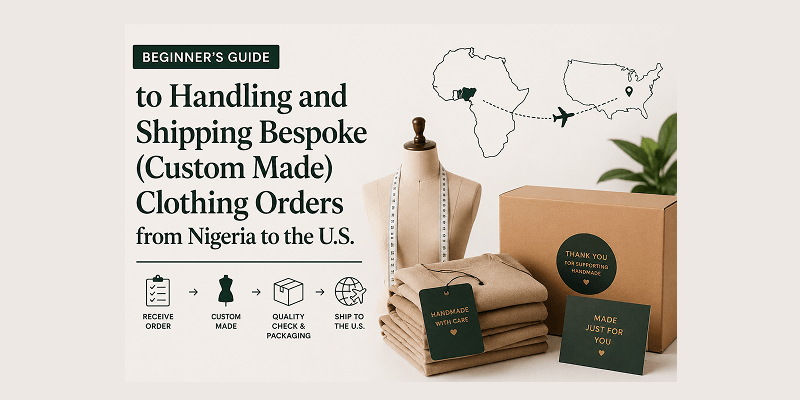
As of 2023, there are nearly 2.8 million African-born immigrants living in the United States, representing a rapidly growing population. Western and Eastern Africa are the largest source regions, with Nigeria, Ethiopia, and Egypt leading as the top countries of origin, contributing nearly half of the total.
If you run a bespoke clothing brand in Nigeria, expanding your business to international clients especially in the United States is a smart move. The U.S. market offers huge opportunities for Nigeria designers and clothing brands who are able to penetrate into the US market through Referrals or digital marketing.
leveraging Channels like social media platforms, Online marketplace, AI platforms and Search engine services, but many beginner designers struggle with one key question: how do I handle and ship bespoke clothing orders from Nigeria to the U.S?
This beginner-friendly guide will walk you through everything you need to know, starting with How to handle customer order, shipping the order to US. to receiving customer reviews and referrals
What is bespoke clothing
Bespoke clothing refers to a garment that is completely custom-made from scratch for a specific client, based on their exact measurements, style preferences, and personal requirements.
To successfully process and deliver a bespoke order for an international client, a designer or brand must have an efficient order workflow that ensures every stage of the process is handled properly and without mistakes.
Considering the fact that you are dealing with a client outside Nigeria, the process becomes even more delicate, as there is little or no room for physical measurements, fittings, or adjustments after delivery.
Order Workflow
An order workflow is a structured, step-by-step process of managing a customer order from initiation to fulfillment, ensuring accuracy and efficiency.The order workflow of a bespoke clothing consist of the following stages:
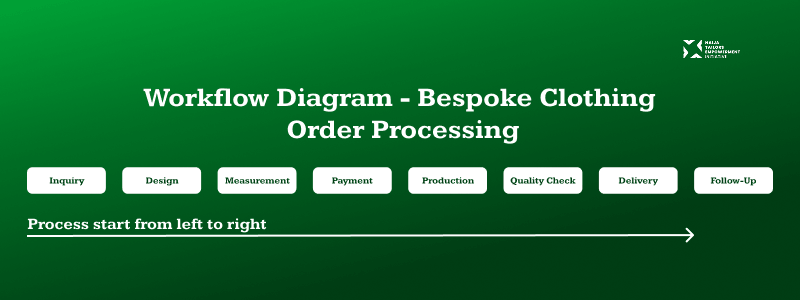
Inquiry → Design → Measurement → Payment → Production → Quality Check → Delivery → Follow-Up
1. Inquiry or Client Consultation
This is where the journey starts. Clients typically reach out via WhatsApp, Instagram, or a website, and discussions usually cover:
- Occasion (wedding, casual, corporate)
- Style preferences (photos, sketches)
- Fabric choice
- Customer budget
- Order delivery timeline
Order delivery timeline usually includes the timeframe within which the product will be ready for shipment and the estimated time it will take for the order to arrive at the customer’s doorstep. It is always advisable for businesses to include extra days in their delivery policy and clearly inform clients that delays may occur due to logistics companies.
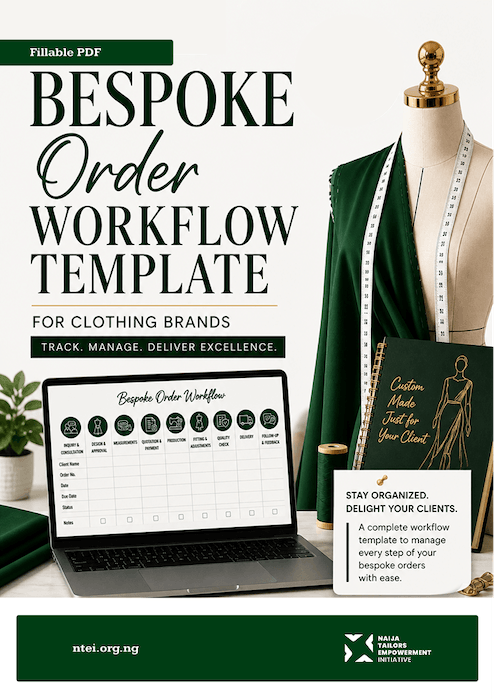
Stay organized, delight your clients with our complete workflow template to manage every steps of your bespoke orders with ease. Download Now
2. Style Selection & Design Approval
This is the stage where you convert the client’s idea into something clear and actionable. Remember to get written approval, preferably in the form of a message, for the final design. When putting the final style together, always keep in mind that the customer’s size, fabric type, and design accessories directly affect the total weight of the finished product, which also affects the shipping cost. We will discuss shipping costs and logistics in detail later in this article.
3. Client Measurements
When dealing with international clients for custom-made clothing, physical measurement is usually not possible. Businesses either carry out the measurement virtually (recommended) or rely on customers to get their measurements taken in their location, which can be risky since the designer or business cannot verify the accuracy of the data.
Virtual measurement in tailoring is a remote measurement method where a client’s body measurements are collected digitally without physical contact, using tools such as video calls (highly recommended), client photos, or body scanning and measurement apps. Check out our blog post: How to take virtual measurements via video call.
4. Order Cost and Payment
This is the stage where customers validate their orders by making a financial commitment, either through full or part payment. There are three main factors a designer needs to consider in order to avoid overcharging or undercharging clients.
Pricing Strategy: Some designers prefer to include shipping costs when giving clients the total bill, thereby covering any extra expenses that may arise after a price has been agreed upon. Other designers focus only on the production cost, allowing customers to handle delivery costs and any import duties separately after the order has been completed.
Customers are more likely to prefer the first strategy since it provides clarity before any commitment is made. However, designers must find a way to accurately estimate shipping costs and any related fees that may arise during shipment.
Order Costing: Depending on the designer’s pricing strategy, order costing refers to the total cost required to successfully execute the project. This includes the cost of fabrics, design accessories, production, packaging, package drop-off, shipping fees (logistics companies usually include insurance and VAT in their pricing), and possible import fees.
Client Payment: Designers should have a clear payment policy. Clients can either make full payment for an order or pay a deposit and complete the balance before the order is delivered.
It is important for designers to maintain a proper balance between pricing and payment to ensure customers are neither undercharged nor overcharged, as this can affect the chances of customers validating their orders.
5. Production and Quality Check
Once payment is confirmed, the next stage is production, which could be outsourced, handled in-house, or a combination of both. Whichever the case, designers do not get a second chance with international clients and returns are expensive. Therefore, you must ensure:
- Measurements are double-checked
- Neat finishing
- Durable accessories such as zippers, threads, and buttons are used
- Correct sizing
- Clean finishing
- brand label stitched
- No stains or defects
- Proper ironing and packaging

6. Delivery
Everything discussed above becomes pointless if the customer does not receive their order. This is why the delivery stage is both very important and delicate. Let’s look at some common terminologies used by logistics companies.
Customer Delivery Details: As the name implies, these are the delivery details of your client. Designers must ensure that the customer’s delivery information is accurately captured, as even a simple typographical error can cause significant complications and delays in the delivery process.
Required customer details for international orders:
- Full name
- Phone number
- Email address
- Full address (including area/ZIP code)
Shipping Methods: This refers to how the customer’s order will be delivered to their location. Typically, shipping is done either by air or by cargo.
- Air shipping is fast but more expensive.
- Cargo shipping takes several weeks but is more affordable and ideal for bulk orders.
Most logistics companies offer two types of air delivery:
- Express delivery: 1–3 business days
- Standard delivery: 5–12 business days
Designers should be able to determine the most suitable delivery method and timeframe from the inquiry stage.
Delivery Fee: This is the total cost required to transport the customer’s order from Nigeria to their destination anywhere in the world. The delivery fee is largely determined by the total weight of the package (including packaging) and the customer’s location.
Most logistics companies provide cost estimation tools that can generate accurate shipping quotes when given details such as order weight, delivery address, item value, and quantity.
Delivery fees typically include:
- Pick-up fee
- Shipping cost
- Insurance coverage
- VAT (Value Added Tax)
Import fees: In August 2025, the Trump administration imposed a 15% tariff on Nigerian imports, impacting sectors like fashion by increasing costs for apparel exported to the U.S. US import duty is calculated by multiplying the total value of goods (including shipping and insurance) by the specific duty rate (15% for Nigeria) assigned by their Harmonized System (HS) code.
Package is sent back to Nigeria after three days by the US immigration if customer fails to clear import duty,
Check out our article The Impact of Trump Tariffs on Nigerian Fashion Brands Exporting to the U.S
7. Follow-Up
This is where many brands drop the ball. This step helps you grow faster than ads and brand should do the following instead
- Provide tracking number
- Confirm delivery
- Ask for feedback
- Request photos/testimonials
- Encourage referrals
Common Mistakes to Avoid
- Avoid animal parts like feather (synthetic or real), skin leather etc. in your designs
- Include cotton on item tittle (e.g female native gown made of cotton )
- Remove unnecessary weight by choosing the right design accessories and box size when packaging your order